
A teacher needs 28 completion certificates by Friday. She opens a new file, types a title, and spends an hour nudging a border, centering a name, and fixing a signature line that keeps jumping to page two. Next month, she does it all again from scratch.
A reusable certificate template in Google Docs removes that repeat work. You design one clean landscape page, save it as a master, and make a copy for each recipient. Google Docs is the editor, and Google Drive stores the master file, so the template is available from any device and easy to share with a co-organizer.
This guide shows how to set up the page, add a border, build the text layout, insert a logo and signature, generate multiple certificates, export a PDF, and protect recipients’ names and data.
Plan the Certificate Before You Open Docs
Decide what the certificate needs to say before you design anything. A few minutes of planning prevents layout changes later. Most certificates include:
- A title, such as “Certificate of Completion”
- A line like “This certifies that”
- The recipient’s name
- A short reason, such as the course or achievement
- A date
- The name and title of the person who issues it
- A signature line and, optionally, a logo or seal
Check whether your school, company, or program has required wording or branding. Also decide how you’ll distribute the finished files. A printed certificate needs a print-friendly layout. A digital one needs a PDF that opens on any device.
Pro Tip: Write the wording in a separate note first. Long course titles and names are what break layouts, so test your longest realistic text early.
Set Up the Page in Landscape
Certificates are usually landscape, meaning the page is wider than it is tall. Docs opens in portrait by default, so change this first.
- Open a Blank document in Google Docs.
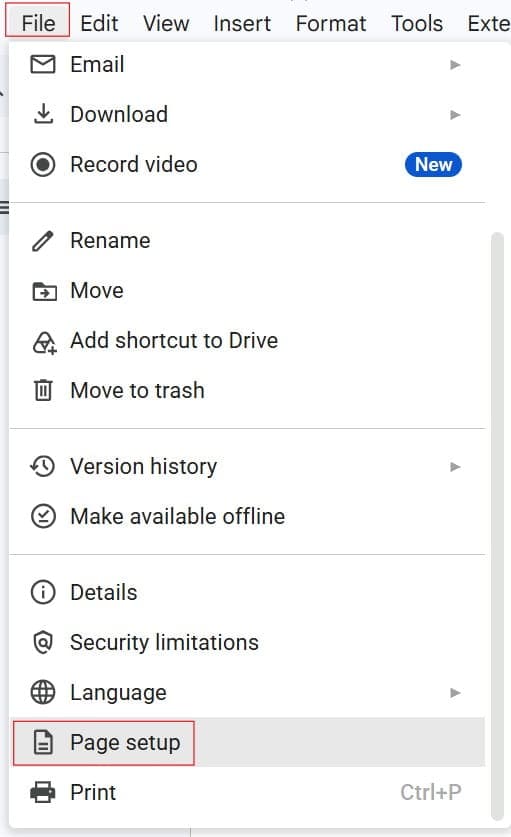
- Select File, then Page setup.
- Make sure the Pages tab is selected. Orientation and margins do not apply in pageless format.
- Set Orientation to Landscape.
- Choose your paper size, such as Letter or A4, depending on where you print. See Google Docs page size for help.
- Set margins. Try 0.5 to 1 inch so you have room for a border without losing text at the edge. Read how to change margins in Google Docs for more detail.
- Select OK. Check out the screenshot below for your reference.
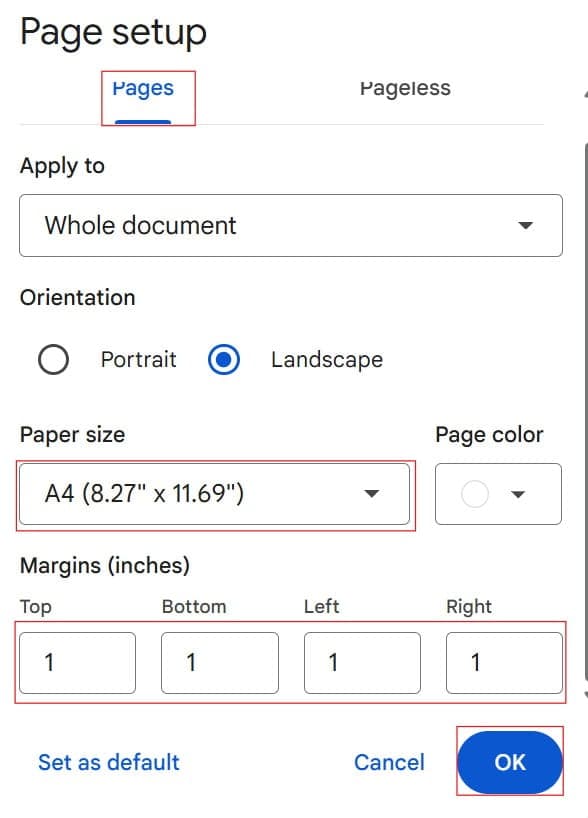
Why this matters: Docs decides where text wraps and where the page ends based on these settings. If you design on one paper size and print on another, the layout shifts. Home and office printers often can’t print right to the paper edge, so a very thin margin may clip the border.
Pro Tip: Do not select Set as default in Page setup unless you want every new document to open in landscape. It affects your future files.
Add a Border and Background
A border gives a certificate its finished look. Docs has no one-click “certificate border,” but you have good options.
Option 1: Use a one-cell table.
- Select Insert, then Table, and choose a 1 by 1 grid.
- Drag the table edges so it fills the page inside your margins.
- Right-click inside the table and choose Table properties.
- Set Table border to a color and thickness you like, such as 3 or 4 points.
- Use Cell vertical alignment to center content if you want it centered on the page.
This keeps your text inside the border and moves with it. For related options, see how to add borders in Google Docs.
Option 2: Draw a shape. Use Insert, then Drawing, then New, add a rectangle with no fill, and insert it. Drawings float around text and can be harder to align. Learn the basics in how to insert shapes in Google Docs, or use lines from how to draw lines in Google Docs.
Background color. Use File, then Page setup, then Page color for a soft tint. Many printers waste ink on dark backgrounds, so a light color or white is safer. You can also learn about backgrounds in Google Docs if you want a design image behind the text.
Pro Tip: Use a table border for a simple frame. It is more stable than floating shapes, which can shift when you edit text.
Build the Text Layout
With the frame ready, add the content. Keep the hierarchy clear so the recipient’s name stands out.
- Type the title, such as
CERTIFICATE OF COMPLETION. Use a larger font, around 36 to 48 points, and center it. See how to center text in Google Docs if you need a refresher. - Add a line such as
This certifies that. Use a smaller size, around 16 points. - Add the recipient’s name. Use the largest size on the page after the title, such as 36 points, in a script or serif font.
- Add a line describing the achievement, such as
has successfully completed the Project Management Workshop. - Add the date and issuer details at the bottom.
Use styles for the title. Select the title and apply Title from the styles dropdown, then adjust the font. Using a style helps screen readers and keeps your template consistent.
For the signature area, a borderless table helps:
- Insert a table with two or three columns and one row.
- Right-click and choose Table properties, then set the border width to 0.
- In each cell, type a line of underscores or insert a horizontal line, and add the label below it, such as
InstructororDate.
Put the date and signature lines side by side near the bottom. Keep important text away from the very edge so printers don’t cut it off.
Fonts matter. Choose two at most: one decorative for the name and one simple for body text. Check that the fonts are available on any computer where you print, because missing fonts are replaced and change the look. Also check contrast. Dark text on a light background is easier to read, including for people with low vision.
Pro Tip: Use placeholder text like
[Recipient Name]in the master. It makes the fields easy to find and replace, and you can search for the brackets withCtrl+F(Cmd+Fon Mac).
Add a Logo and Signature
A logo makes a certificate look official. Use a clear, high-resolution image so it prints well.
- Place the cursor where the logo should go, often at the top center.
- Select Insert, then Image, then Upload from computer.
- Resize the image using the corner handles so it stays in proportion.
- Choose the layout options in the toolbar, such as In line for easy alignment.
- Right-click the image, choose Alt text, and write a short description like “Company logo.”
For alignment and cropping, see how to center an image in Google Docs. If your letterhead has a standard header, create a letterhead in Google Docs and reuse the logo.
For signatures, you have three choices. You can leave a blank line for a handwritten signature after printing. You can insert a scanned signature image. Or you can draw one using Insert, then Drawing. Read how to insert a signature in Google Docs for steps. If the issuer needs to sign a finished PDF, see how to sign a PDF in Google Docs.
Treat a signature image like private data. Anyone who can open or download the file may copy it. Only use a digital signature image where your organization allows it, and restrict who can edit the master.
Pro Tip: Keep the signature image in a separate, restricted file in Drive and insert it only into final copies.
Save the Master and Make Copies
Once the design is final, protect it. This is the step that saves time later.
- Replace names and dates with placeholders.
- Name the file clearly, such as
Certificate-Template-Master-Completion. - Move it to a folder like
Training / Templates. - For each certificate, select File, then Make a copy.
- Rename the copy, such as
Certificate-Maria-Lopez-2026-10, and fill in the details.
Never type recipient names into the master. If you do, you may overwrite the template, and every future copy inherits the mistake. If that happens, open File, then Version history, then See version history and restore an earlier version. Restoring replaces the current content, so name the present version first. If a file disappears, try recovering a file from Google Docs.
Some Workspace organizations can add templates to a shared gallery, so staff see them in Docs. Availability depends on your plan and admin settings, so ask your administrator.
For large groups, mail merge can fill in names from a spreadsheet. Google Docs has no native mail merge, so people use add-ons that connect a Google Sheet to a document. Add-ons require permissions, so read what access they request, and check whether your school or company allows them before you load student or employee names.
Pro Tip: Set the master to Viewer for everyone except you. Others should always copy it, never edit it.
PDF is the best format for finished certificates because it preserves the layout.
- Open the filled-in copy.
- Select File, then Download, then PDF Document (.pdf).
- Open the PDF and check the name, spelling, border, and page count. A certificate should fit on one page.
If you need an editable copy, download DOCX, but fonts and borders may change in other apps. Always check the result.
To print, use File, then Print. Choose the correct paper size and set scale to 100%. If a border is cut off, widen the margins or turn off any “fit to page” option that shrinks it. When printing fails, see why you can’t print from Google Docs. Use heavier paper for a more formal look, if your printer supports it.
When you share, think about privacy. A certificate includes a person’s name and sometimes their achievement or employer. Share files with named recipients, not public links. Use Share, add the email address, and choose Viewer so they can read but not change it. Read Google Docs Commenter vs. Editor for role differences, and see how to make a Google Doc view-only.
Anyone with the link can expose a certificate to people you did not intend, since links can be forwarded. Check the recipient list and general access before you send. Administrators at schools and companies may restrict external sharing.
Also remember that a Google Docs certificate is not a security document. Anyone can recreate a similar design. If certificates must be verified, such as for professional training, keep a record of issued certificates and consider a certificate number that you can check against that record.
Pro Tip: Send the PDF, not the Google Doc, and keep the editable copy in your own Drive.
Troubleshooting Certificate Layout Problems
Start with simple checks.
- Content spills to a second page. Reduce font sizes or spacing, shorten text, or trim the margins slightly.
- Border is cut off in print. Increase margins and make sure printer scaling is 100%.
- Name is not centered. Select the paragraph, apply center alignment, and clear indents under Format, then Align & indent.
- Image moves around. Change the image layout to In line or place it inside a table cell.
- Fonts change after download. Use common fonts or export a PDF to lock the look.
- Cannot edit the file. Check your role. You may only have Viewer access. Ask the owner for edit access.
Frequently Asked Questions
Does Google Docs have certificate templates?
Google Docs may not offer a dedicated certificate option in your gallery, and available templates vary by account. You can start from a blank document and build your own, or upload a DOCX template to Drive and open it in Docs.
How do I make a certificate landscape in Google Docs?
Select File, then Page setup, choose the Pages tab, and set Orientation to Landscape. Select OK. If you don’t see the option, your document may be in pageless format.
How do I make many certificates at once?
Make a copy of the master for each recipient, or use a mail merge add-on that connects to a Google Sheet. Review the add-on’s permissions first, and check your organization’s policy before uploading names.
How do I save a certificate as a PDF?
Select File, then Download, then PDF Document (.pdf). Open the file afterward to check the layout. PDF is better than sharing the editable Doc.
Can I stop people from editing my certificate template?
Yes. Share the master with Viewer access, or keep it in a folder only you can edit. People can still make their own copies if they can view the file, so avoid sharing it widely.
You learned how to set up a landscape page, add a border, build the text layout, insert a logo and signature, create copies, and export a PDF. The key habit is to keep a protected master and share finished certificates with named recipients at the lowest role they need. I hope you found this article helpful.
You May Also Like
- Teacher borders for Google Docs
- How to make a flyer in Google Docs
- Google Docs newsletter template
- Magazine template in Google Docs
- Memo template in Google Docs

I am Rajkishore, and I have over 14 years of experience in the Software Industry. For a long time, I have been using Google Docs, Google Drive, and Google Sheets for my document usage, and I am sharing all the tips and tricks, the challenges I have come across, and their solutions to use Google Docs for your day-to-day use. I hope you will learn from these practical Google Docs tutorials. Read more.