
Four friends plan a long weekend trip. Flight times live in one email, the hotel address sits in a text message, and the dinner reservation is in someone’s notes app. On the morning of the trip, nobody can find the check-in time, and the phone signal at the airport is weak.
A reusable Google Docs itinerary template puts everything in one document. You build a simple layout once, copy it for each trip, and share it with the people who need it. Google Docs is the editor, and Google Drive stores your files, so the plan is available from a phone, tablet, or laptop. The same layout also works for business trips, school field trips, conferences, and event schedules.
This guide shows how to design the layout, add tables, times, links, and maps, make the plan work offline, and share it without exposing private travel details.
Plan What the Itinerary Must Include
Before you open Docs, decide who will use the itinerary and what they need at a glance. A solo traveler needs different details than a group, and a conference schedule needs different details than a family vacation.
A practical itinerary usually includes:
- Trip name, dates, and destination
- Travelers and emergency contacts
- Transport details: flights, trains, car rental, pickup times
- Lodging: name, address, check-in and check-out times
- A day-by-day schedule with times and places
- Reservations and tickets
- Notes: packing reminders, weather, or local tips
Do not store passport numbers, payment card details, passwords, or full booking login information in the document. Keep sensitive details in a secure place and put only what is needed to travel, such as a reservation name or the airline and flight number.
Pro Tip: Write down the three questions travelers ask most, such as “Where do we meet?” and “What time is check-in?” Put those answers at the very top.
Set Up the Page and Document Structure
Start with a Blank document. You can choose portrait for a simple list or landscape for wide tables.
- Select File, then Page setup.
- In the Pages tab, choose the orientation. Landscape often works better for a table with many columns.
- Choose your paper size, such as Letter or A4, based on where you print.
- Set margins to about 0.75 to 1 inch. See how to change margins in Google Docs if you need help.
- Select OK. Check out the screenshot below for your reference.
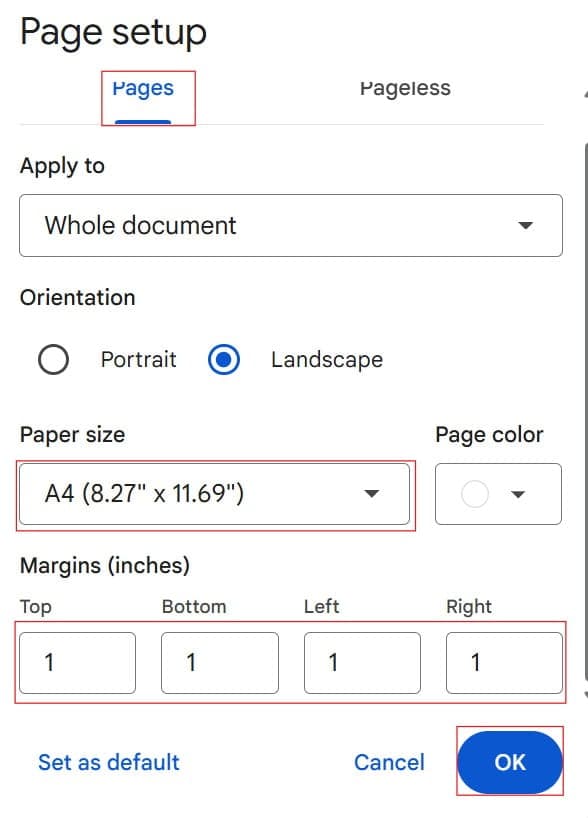
Orientation and margin settings do not apply in pageless format, so switch to a paged layout if you plan to print.
Now add structure. Type the trip title and apply the Title style from the styles dropdown. Use Heading 1 for sections such as “Flights” and “Hotel,” and Heading 2 for each day. Real heading styles do two useful things.
They fill the outline panel on the left so you can jump between days, and they help screen readers move through the document.
Pro Tip: Use short, consistent headings like “Day 1 – Arrival” and “Day 2 – City Tour.” They are easy to scan on a phone.
Build the Daily Schedule Table
A table is the best way to show a schedule, because it keeps times, activities, and locations lined up.
- Under your first day heading, select Insert, then Table.
- Choose a grid, such as 4 columns by 6 rows.
- Label the top row: Time, Activity, Location, Notes.
- Fill in a sample row, such as
9:00 AM,Breakfast,Hotel restaurant, andReservation under group name.
Why a table? Plain paragraphs make times drift out of alignment, especially when a line wraps on a small screen. Tables stay organized, and you can sort your thoughts by row. For more help, see how to make a table in Google Docs.
Customize the table:
- Select the header row and add shading through the toolbar for readability.
- Merge cells for a full-width note by selecting them and using the merge option in the right-click menu. See how to merge cells in a table.
- Fix a table that runs off the page with how to make a table fit the page.
- Highlight critical items such as flight departure times. Learn how in highlighting text in Google Docs.
Keep columns narrow enough to read on a phone. If a table has more than four columns, text can become tiny. Consider splitting a long table into “Morning,” “Afternoon,” and “Evening” sections instead.
Pro Tip: Build one day completely, then copy and paste the table for each remaining day. Change only the heading and the content.
Add Dates, Places, and Checklists
Docs includes tools that make an itinerary more useful than a plain list.
Date chips. A smart chip is a small interactive element that represents a date, person, file, or place. Select Insert, then Date to add a date you can click and update. Type @ to see other chip options, which vary by account and update.
Place chips. In many accounts, typing @ and a place name can insert a place chip with a map preview. Availability can vary, so look in Insert, then Smart chips if you don’t see it. A map chip saves guests from copying addresses into another app.
Checklists. Add a packing or to-do list with a checklist. In the toolbar, look for the checklist icon, or choose Format, then Bullets & numbering, then Checklist. Travelers can tick off passport, charger, tickets, and medication.
Dropdowns. Use Insert, then Dropdown to create a status field, such as “Booked,” “Pending,” or “Cancelled.” This helps groups track what is confirmed.
Links. Link to booking pages, maps, or other documents. Use descriptive text such as “Hotel check-in details” rather than a long web address. Read how to link to another document in Google Docs for linking to separate files, and how to shorten a Google Docs URL when you need a cleaner address.
Pro Tip: Put the address, phone number, and check-in time of each hotel in the same row or section. Travelers should not have to search for them.
Add Photos, Tickets, and Layout Polish
A clean layout makes the plan usable under pressure, such as at a gate with a dying phone battery.
- Use one or two fonts. A clear sans-serif font at 11 or 12 points reads well on a phone.
- Add space between sections by using paragraph spacing instead of many blank lines.
- Insert a header with the trip name and dates using Insert, then Headers & footers.
- Add page numbers so printed pages stay in order.
- Insert photos of tickets or QR codes if you need them, and add alt text to images. If you plan to center a map or photo, see how to center an image in Google Docs.
Be careful with images of tickets, boarding passes, or IDs. They can contain personal data and barcodes. Only include what your travelers need, and think twice before sharing a document that contains scannable codes.
Pro Tip: Use a light color for table headers and keep text black. High contrast is easier to read in bright sunlight.
Save the Master Template
Once the layout is ready, turn it into a template.
- Replace trip-specific details with placeholders, such as
[Destination],[Hotel name], and[Flight number]. - Name the file
Itinerary-Template-Master. - Store it in a Drive folder such as
Travel / Templates. - For each trip, open the master and select File, then Make a copy.
- Rename the copy, for example
Itinerary-Lisbon-2027-03.
Never plan inside the master. If you do, you may overwrite the template and carry old details into future trips. If that happens, open File, then Version history, then See version history, and restore an earlier version.
Restoring replaces current content, so name the current version first. If a file goes missing, try recovering a file from Google Docs.
Some Workspace organizations can add templates to a shared gallery for staff travel. Availability depends on your plan and admin settings, so ask your administrator.
Pro Tip: Keep a “Master with sample data” and a “Master blank.” The sample shows new users how to fill it in.
Group trips need collaboration. Use Share at the top right, add specific email addresses, and choose a role.
| Role | What the person can do | Best use |
|---|---|---|
| Viewer | Read only | Family members who only need the plan |
| Commenter | Read and comment | Friends suggesting changes |
| Editor | Change the content | Co-planners you trust |
Choose the lowest role that fits. See Google Docs Commenter vs. Editor for a deeper comparison, and how to make a Google Doc view-only for a final version. If some travelers don’t use Gmail, read how to share Google Docs with non-Gmail users.
Use Suggesting mode, found in the editing mode dropdown near the top right, when several people propose changes. The owner can accept or reject each suggestion. Use comments for questions like “Is dinner at 7 or 8?”
Privacy deserves extra thought for travel. An itinerary reveals when you will be away from home, where you are staying, and your daily patterns. Do not post it publicly. Anyone with the link can expose the document to people you did not intend, and links can be forwarded.
Share with named people, check the recipient list before sending, and remember that school and company admins may restrict external sharing. For business trips, follow your employer’s rules about storing traveler details.
Pro Tip: When the trip ends, change access to Restricted or archive the file. Old itineraries have no reason to stay widely shared.
Make the Itinerary Work Offline
Travel often means weak signals. Docs can work offline, but you must prepare before you go.
- On a computer, use Chrome or Microsoft Edge and turn on offline access in Google Drive settings while online.
- On a phone or tablet, open the Docs app, find your itinerary, open the file’s menu, and choose Available offline.
- Wait for the check mark that confirms the file is saved.
- Open the file in airplane mode to test it.
Not every file is available offline automatically, so mark the itinerary yourself. The full steps are in how to make Google Docs available offline.
Also keep a backup. Download a PDF through File, then Download, then PDF Document (.pdf), and save it to your phone or print it. See how to save Google Docs to your computer for download options. Remember that a downloaded copy is separate from the cloud original, so changes made later will not appear in it. Download again after major updates.
Pro Tip: Check the offline copy the night before you leave. Update it, download a fresh PDF, and confirm it opens without Wi-Fi.
Troubleshooting Itinerary Problems
Start with the simple checks.
- Table runs off the page. Resize columns or switch to landscape.
- Text wraps badly on a phone. Reduce the number of columns or increase column width.
- Place chip is missing. Your account or version may not offer it. Use a plain link to a map instead.
- Offline file won’t open. Confirm you marked it offline while connected and that you use a supported browser or the Docs app.
- Changes not showing for others. Check your role and the sharing settings. They may be viewing an old PDF copy.
- Layout changes after download. Export a PDF, which keeps the layout fixed.
You learned how to set up the page, build a daily schedule table, add smart chips and checklists, save a master template, and prepare it for offline use. The most important habit is to share travel plans with named people at the lowest role they need and keep sensitive details out of the document. I hope you found this article helpful.
Frequently Asked Questions
Does Google Docs have an itinerary template?
Your template gallery may include travel-related options, but availability varies by account. You can always build your own with a table, headings, and a few smart chips, then save it as a master and copy it for each trip.
How do I make a travel itinerary in Google Docs?
Create a blank document, add a title and day headings, insert a table with time, activity, location, and notes columns, and fill it in. Then add links, checklists, and a header. Save the file in a Drive folder.
Can I use my Google Docs itinerary offline?
Yes, if you turn on offline access or mark the file as available offline before you lose connection. Test it in airplane mode, and keep a PDF backup.
Select Share, add named people, and choose Viewer. You can also send a PDF copy. Avoid public links for travel plans.
How do I turn my itinerary into a PDF?
Select File, then Download, then PDF Document (.pdf). Open the file to check page breaks and tables before you share it.
You May Also Like
- Agenda template in Google Docs
- Journal template in Google Docs
- Recipe template in Google Docs
- Birthday invitation template in Google Docs
- Booklet format in Google Docs

I am Rajkishore, and I have over 14 years of experience in the Software Industry. For a long time, I have been using Google Docs, Google Drive, and Google Sheets for my document usage, and I am sharing all the tips and tricks, the challenges I have come across, and their solutions to use Google Docs for your day-to-day use. I hope you will learn from these practical Google Docs tutorials. Read more.