
You paste a paragraph into a report, and one line suddenly has huge gaps between words, like “The results show”. Another line looks cramped, and a third has a space that will not go away no matter how many times you press Delete. The text looks sloppy, and you cannot tell why.
Google Docs spacing between words problems usually have one of five causes: justified alignment, extra typed spaces, tabs, special space characters from pasted text, or narrow columns. Each has a different fix. Google Docs is the editor, and the formatting lives in the document itself, so a fix you make applies in Drive, in a shared copy, and in any PDF you export.
This guide helps you find the real cause, fix it with menus or find and replace, prevent it from returning, and avoid breaking a shared document while you clean it.
Understand What Controls Word Spacing
Before you fix anything, it helps to know what Docs controls and what it does not. Many readers search for a “word spacing” setting, but Docs has no dedicated slider for the width of a space. Instead, the gaps come from other things:
- Alignment. Justified text stretches spaces so both edges of a paragraph line up.
- Typed spaces. Pressing the spacebar more than once adds real extra characters.
- Tabs. A tab character jumps to the next tab stop and can look like a large space.
- Non-breaking spaces. These are special space characters, often from web pages and other apps, that act differently from normal spaces.
- Narrow columns or indents. A short line width gives justified text little room, so gaps grow.
- Font choice. Some fonts have wider spaces than others.
Do not confuse word spacing with line spacing. Line spacing is the vertical gap between lines and is set under Format, then Line & paragraph spacing. This article covers the horizontal gaps between words. Menu labels can differ by language and product updates.
Pro Tip: Diagnose before you fix. Changing alignment solves a justified-text gap in one click, while find and replace solves typed spaces. Using the wrong fix wastes time.
Step 1: Check Whether Justified Alignment Is the Cause
Justified alignment spreads words so each line reaches both margins. It looks tidy in print, but on a short or narrow line it creates wide gaps. If only some lines have large gaps, and the last line of a paragraph looks normal, this is likely the problem.
- Click inside the paragraph with the gaps.
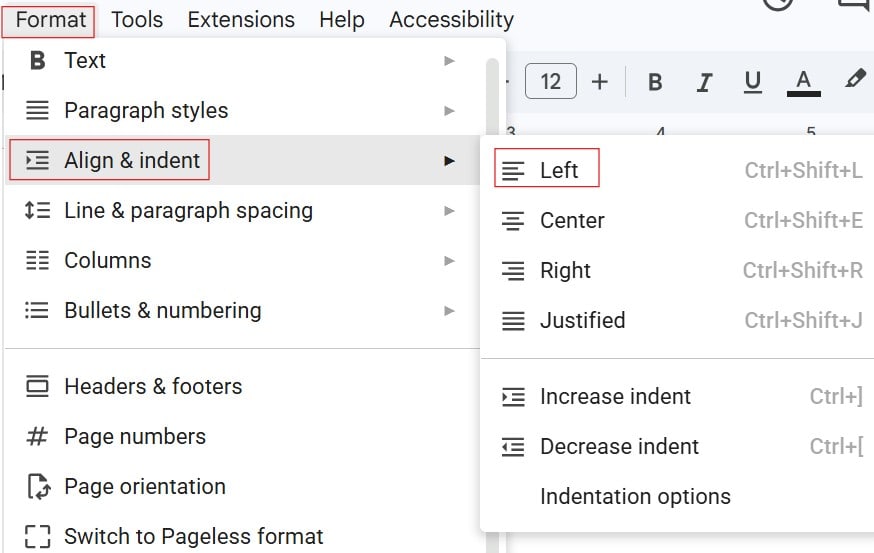
- Look at the toolbar for the alignment buttons, or select Format, then Align & indent.
- If Justified is active, choose Left instead. The shortcut is
Ctrl+Shift+Lon Windows and ChromeOS, orCmd+Shift+Lon a Mac. - Check whether the gaps close.
Check out the screenshot below for your reference.
Left alignment leaves a ragged right edge, but the spacing between words stays even. Many style guides, accessibility guidelines, and readers prefer it, since the uneven gaps in justified text can make reading harder, especially for people with dyslexia. If you need centered text for a title, see how to center text in Google Docs.
If you must keep justified text, widen the text area. Reduce the margins slightly under File, then Page setup, or increase the column width. For help, read how to change margins in Google Docs.
Pro Tip: Use left alignment for reports, emails, and web-bound documents. Save justified text for wide, single-column pages with longer lines.
Step 2: Reveal Hidden Characters
If alignment is not the cause, look at what is actually in the text. Hidden characters, such as extra spaces, tabs, and line breaks, are invisible by default.
- Select the View menu.
- Look for an option to show non-printing characters or formatting marks. The label may vary by version and language.
- Turn it on and look at the problem line.
You may see dots for spaces, arrows for tabs, and symbols for paragraph ends or line breaks. Three dots in a row between two words means three typed spaces. An arrow means a tab. Learn more in how to show formatting in Google Docs.
Why does this matter? Pressing Delete over and over on a mystery gap may remove the wrong character. Seeing the character tells you which fix to use.
Pro Tip: Turn on formatting marks whenever you edit pasted text. It takes seconds and shows problems before readers do.
Step 3: Remove Extra Spaces With Find and Replace
When the text contains double or triple spaces, Find and replace cleans them all at once. This is the fastest fix for a long document.
- Press
Ctrl+Hon Windows and ChromeOS, orCmd+Shift+Hon a Mac. You can also use Edit, then Find and replace. - Check Match using regular expressions. A regular expression is a pattern that matches text, and Docs uses it to find repeated characters.
- In the Find box, type two or more spaces as a pattern:
{2,}(a space, followed by{2,}). - In the Replace with box, type a single space.
- Select Replace all.
The pattern means “two or more spaces in a row.” Replacing them with one space leaves normal single spacing. Docs will show how many replacements it made.
Before you click Replace all, think about the document. If it is shared, a global replace changes the text for everyone, and it can affect places where extra spaces were intended, such as aligned columns made with spaces. Use Replace one match at a time if you want more control, and tell collaborators first. If something goes wrong, press Ctrl+Z (Cmd+Z on Mac) immediately, or use version history. For a full walkthrough, see how to remove extra spaces in Google Docs.
A note on style: older typing habits put two spaces after a period. Many modern style guides use one. If your teacher or editor asks for one, this step handles it.
Pro Tip: Name a version in File, then Version history, then Name current version, before running a global replace. If the result looks wrong, you can restore it.
Step 4: Fix Special Spaces and Tabs
Sometimes the gap is not a normal space. Text copied from a web page, PDF, or another app can include non-breaking spaces, which look like a space but behave differently and may not be removed by the previous step.
- Open Find and replace again.
- Check Match using regular expressions.
- To find non-breaking spaces, type
\x{00A0}in the Find box. - Type one normal space in Replace with.
- Select Replace all.
For tabs, search for \t and replace it with a single space, or with nothing if the tab was unintended. Be careful: some documents use tabs on purpose for indents or aligned lists. Check the text first, and use Replace one at a time if you are not sure.
Text with odd line breaks can also look spaced out. A soft line break, created by pressing Shift+Enter, forces a new line without starting a new paragraph. In a justified paragraph, a line that ends in a soft break can stretch to fill the width. If that happens, replace the break with a normal space or change the alignment.
Pro Tip: If the gap survives every fix, retype the space by hand around that spot. A single odd character is sometimes quicker to replace than to diagnose.
Step 5: Prevent Gaps When You Paste
Most spacing trouble starts when you paste. Source text carries its own formatting and special characters. A few habits stop it at the door.
- Paste as plain text with
Ctrl+Shift+V(Cmd+Shift+Von Mac). This drops the original formatting. See how to paste in Google Docs without formatting. - When you need to keep some formatting from a Word file, follow how to copy and paste from Word to Google Docs with formatting, then check spacing.
- Use Format, then Clear formatting (
Ctrl+\on Windows,Cmd+\on Mac) on a stubborn paragraph to reset its look. - If you want to apply the same look across text, learn how to copy formatting in Google Docs.
- Check how to stop Google Docs from auto-correcting if automatic replacements change spaces or punctuation as you type.
If a whole document came from another source, such as a PDF or an imported file, spacing issues are more likely. Convert and review it before you share.
Pro Tip: Treat pasted text as a draft. Paste as plain text, then apply your own styles so the document keeps one consistent look.
Fix Spacing in Columns, Tables, and Line Breaks
Layout can create gaps even when the text is clean.
Columns. Narrow columns plus justified text almost always produce wide gaps. Use left alignment or widen the columns. To set them, see how to make multiple columns in Google Docs and how to format columns.
Tables. Text in a narrow table cell may wrap awkwardly. Widen the column or reduce the font size.
Blank lines. People often add empty paragraphs to create space. This is not word spacing, but it affects layout. See how to make a blank line in Google Docs and use paragraph spacing instead of many blank lines.
Text running off the page. If words extend past the margin or wrap strangely, check why Google Docs words go off the page.
Pro Tip: Fix layout before text. Set margins, columns, and alignment first, then clean the text. Otherwise, edits may reintroduce gaps.
If several people edit one document, spacing habits spread. Use clear rules and the right permissions.
Share with named people through Share, and give Commenter access to reviewers who only need to point out spacing issues. Editor access lets people change text, including with find and replace. Read Google Docs Commenter vs. Editor to choose the right level. Avoid Anyone with the link for drafts that contain private information, since links can be forwarded and admins may restrict sharing anyway.
Use Suggesting mode for cleanup in a team document so others can review changes. Use version history to compare drafts and restore earlier versions. If text disappears, recovering a file from Google Docs explains options.
When you export, spacing can change. A PDF keeps the layout fixed, so it is best for final copies. DOCX files may reflow in Word because fonts and justification differ. Use File, then Download, then choose the format, and check the result. See saving Google Docs as DOCX and converting a Google Doc to Word without losing formatting.
Pro Tip: Before sending a final document, scroll the whole thing with formatting marks on. It takes a minute and catches stray tabs and double spaces.
Word Spacing Cleanup Checklist
- Alignment first. Switch justified paragraphs to left alignment and see whether the gaps disappear.
- Reveal characters. Use formatting marks to find extra spaces, tabs, and line breaks before you edit.
- Regular expressions. Use find and replace patterns for repeated spaces, but check the match count.
- Paste carefully. Paste as plain text to avoid special spaces and leftover formatting.
- Collaborator impact. Tell editors before a global replace, and name a version first.
- Export check. Review PDF or DOCX output, since spacing can shift in other apps.
Frequently Asked Questions
Why is there a big space between words in Google Docs?
The most common reason is justified alignment, which stretches spaces to fill the line. Other causes include extra typed spaces, tabs, non-breaking spaces from pasted text, or narrow columns. Turn on formatting marks to see which one you have.
How do I reduce spacing between words in Google Docs?
Change justified text to left alignment, then remove extra spaces with find and replace. Google Docs has no dedicated control for the width of a space, so you fix the cause rather than adjusting a setting.
How do I remove double spaces in Google Docs?
Open find and replace, check Match using regular expressions, find {2,}, and replace with a single space. Then select Replace all. Name a version first if the document is important.
Can I change character spacing in Google Docs?
Google Docs does not offer a standard character spacing setting in its main menus, though some add-ons or workarounds may exist. Check what your account allows before relying on one, and avoid add-ons with broad permissions for confidential files.
Why does spacing change when I download as Word?
Fonts, justification, and layout rules differ between apps, so text can reflow. Export a PDF for a fixed layout, or open the DOCX in Word and review it before sending.
You learned that word spacing problems in Google Docs usually come from justified text, extra spaces, tabs, or special characters, and each has a clear fix. The best habit is to paste as plain text, reveal hidden characters, and name a version before any global replace in a shared document. I hope you found this article helpful.
You May Also Like
- Google Docs for students
- APA format in Google Docs
- Widow and orphan control in Google Docs
- Vertical text in Google Docs
- How to rotate text in Google Docs

I am Rajkishore, and I have over 14 years of experience in the Software Industry. For a long time, I have been using Google Docs, Google Drive, and Google Sheets for my document usage, and I am sharing all the tips and tricks, the challenges I have come across, and their solutions to use Google Docs for your day-to-day use. I hope you will learn from these practical Google Docs tutorials. Read more.