A coworker shares a link to a public planning document, and you want to read it without leaving your name in the list of viewers. Or you are a teacher, a researcher, or a job applicant who needs to check a shared page and does not want the owner to see which account opened it. The question is reasonable, but the honest answer has limits.
You can view Google Docs anonymously in some situations, mainly when the link is open to anyone and you are not signed in. In other situations, such as a document shared with you by email, you cannot hide who you are. Google Docs is the editor, and Google Drive controls access and activity, so what others see depends on how the file was shared and what kind of account each person uses.
This guide explains what “anonymous” means in Docs, the steps that work, the settings that hide your view history, and the cases where nothing will hide you.
What “Anonymous” Means in Google Docs
When several people open a document at once, Docs shows small avatars at the top right. If you are signed in and were invited by email, others see your name and photo. If you open a public link without signing in, you appear as an “anonymous animal,” such as an anonymous koala or giraffe, with no name or email.
Anonymous animals show up in these situations, according to Google’s help pages:
- The file is shared with Anyone with the link, and you are not signed in.
- Someone opens the link through a messaging app that previews links.
- The same person opens the file in several tabs or devices.
- The viewer does not have a Google Account.
If you use Google through work or school, people in your own domain always show by name. Outsiders who are not signed in show as anonymous animals, if your administrator allows external sharing.
So anonymous viewing has a clear boundary. It hides your identity from people in the document and from the Activity dashboard when you are signed out. It does not make you invisible to your network, your administrator, or any system that records access at a deeper level.
Pro Tip: Think of “anonymous” as “not named in the document.” It is not the same as untraceable, and you should never rely on it for anything that could cause harm.
When You Can and Cannot View Anonymously
The sharing setting decides everything. Check this table first.
| How the document is shared | Can you view anonymously? | What others see |
|---|---|---|
| Anyone with the link | Yes, if you are signed out | An anonymous animal |
| Anyone with the link, and you are signed in | No, you may appear by name to some viewers | Your name or avatar, depending on account type and sharing |
| Restricted, shared with your email | No | Your name, because you were invited individually |
| Shared with your organization only | No | Your name, because you must sign in |
| Private, no access | Not at all | A request-access screen |
Notice the last three rows. If a document is restricted, Google must verify your account before it opens. There is no legitimate setting that lets you read it without signing in. Do not try workarounds to get around permissions. If you do not have access, ask the owner for it.
Also note that if the owner individually invited you, they know you were invited. If you want to avoid being seen as having opened it, the only honest options are to not open it or to ask for a copy in another format.
Pro Tip: If you are unsure how a document is shared, look at the Share button when you open it. A restricted file will usually ask you to sign in or request access.
Method 1: Sign Out and Open the Link
This is the simplest way to view a public document anonymously.
- Open a browser that is not signed in to Google, or sign out of your Google Account.
- Paste the document link into the address bar. Use only a link that was shared with you for this purpose.
- If the document opens, you are viewing it as a signed-out visitor.
- Look at the top right. If other people are in the file, you may see your own avatar as an anonymous animal.
If Google asks you to sign in, the file is not open to the public. Stop there and request access if you need it. Never enter someone else’s login details or a verification code.
Signing out affects only that browser. Other tabs and devices that are still signed in can cause problems, because Docs may show an extra anonymous animal if you open the file more than once. Close all other copies of the document before you open it, and refresh the page.
For help with sign-in and sign-out, see how to log in to Google Docs and how to sign out of the Google Docs app.
Pro Tip: Close old tabs that show the same document. Several open copies can create extra anonymous animals and confuse everyone in the file.
Method 2: Use a Private or Incognito Window
A private window is a clean browser session that does not use your saved sign-in. It is convenient when you do not want to sign out of your main profile.
- In Chrome, press
Ctrl+Shift+Non Windows or ChromeOS, orCmd+Shift+Non a Mac, to open an Incognito window. - In Firefox, use
Ctrl+Shift+P(Cmd+Shift+Pon Mac) for a Private window. In Edge, useCtrl+Shift+Nfor an InPrivate window. In Safari, use File, then New Private Window. - Paste the document link and press
Enter. - If the document is public, it opens without signing in.
- Close the private window when you finish. Your session ends and the browser removes its temporary data.
Why this works: the private window has no Google cookies, so Google sees a visitor without an account. It does not hide your internet address from the website or your network. Your employer, school, or internet provider may still see that you visited a Google address.
Private mode also disables some features, such as offline access. If you want to work offline later, you need a normal window. See how to make Google Docs available offline.
Pro Tip: Use private mode on a shared computer so your Google session does not remain after you leave.
Method 3: Hide Your View History in Google Workspace
If you use a work or school account, Docs may include an Activity dashboard. It lets people with edit access in the same organization see who viewed a document and when. You can control whether your own views appear.
Turn off view history for one file:
- Open a file from your work or school organization on a computer.
- Select Tools at the top.
- Turn off Show my view history for this document. The exact label can vary by update.
Turn off view history for all files:
- Open the Google Docs home page.
- Select the Menu icon at the top left, then Settings.
- Under Activity dashboard, turn off Show your view history.
- Select OK.
See the screenshot below for reference.
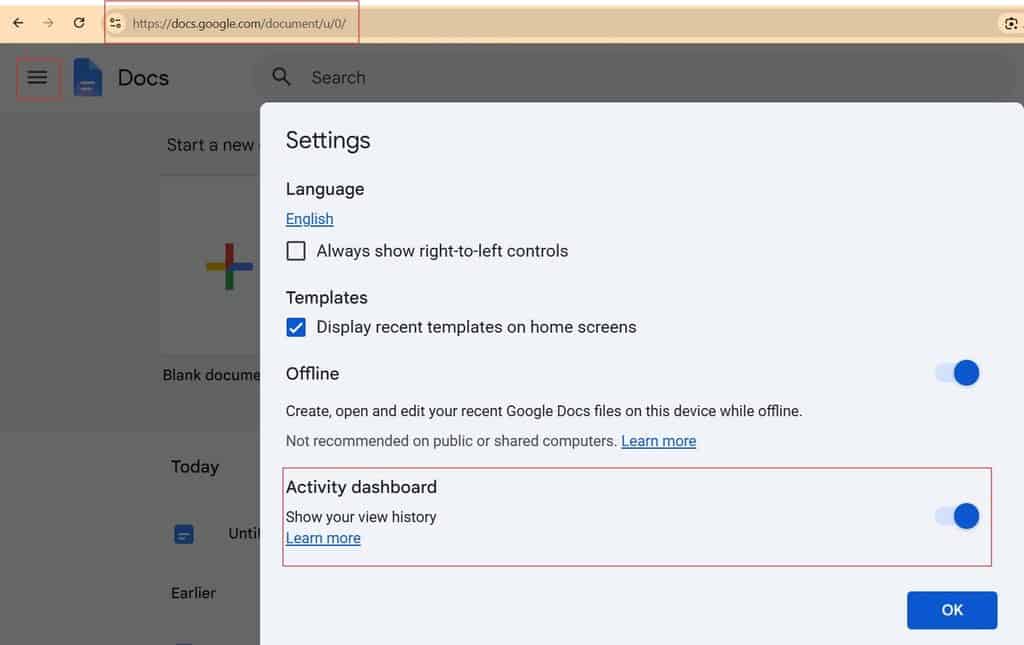
After you turn this off, your views will not appear in the Activity dashboard for anyone’s files, including views you make while it is off. Your past views will return if you turn the setting back on. If your administrator has turned view history off for the whole organization, the dashboard will not show anyone’s views anyway.
Important limits: this setting only controls what the Activity dashboard displays. It does not stop other logs, such as administrator audit records, from existing. Personal Google Accounts do not have an Activity dashboard, so these settings mainly matter for Workspace accounts. Files owned by personal accounts do not show a view history to the owner.
For the owner’s side of the story, see how to check activity on a file or folder in Google Drive and how to delete recent activity on Google Drive.
Pro Tip: Do not assume your administrator cannot see your activity. Work and school accounts are managed, and organizations can keep their own records.
Anonymous Viewing and Editing
A document that allows anonymous viewing may also allow anonymous editing. If the owner set Anyone with the link to Editor, a signed-out visitor can change the text. Their edits appear in version history under a generic name rather than a personal one.
Be careful. If you edit someone’s document anonymously, you may harm their work or violate rules at your school or workplace. Do not make changes unless the owner clearly expects them. If you need to suggest changes, ask for Commenter access or use Suggesting mode with a named account. Learn the differences in Google Docs Commenter vs. Editor.
For accountability, named access is usually better. Anonymous edits are harder to trace, which makes collaboration and review harder.
Pro Tip: If you make anonymous edits with permission, send the owner a short note so they know the changes came from you.
For Owners: Control Who Can View and Be Seen
If you own a document, you decide how visible viewers are.
- Use Restricted access and add named people, so you know who can open the file.
- Choose Viewer for readers who do not need to change anything. See how to make a Google Doc view-only.
- Avoid Anyone with the link for confidential files. Anyone who gets the link can open it, including through forwarded emails or chat previews, and you may see anonymous animals you cannot identify.
- Check General access and the recipient list before you send. Administrators at work or school may restrict external sharing, so some options may be unavailable.
- If outsiders need access, read how to share Google Docs with non-Gmail users.
- Do not rely on a secret link for privacy. A hard-to-guess link is still a link.
If a document is not behaving as expected when you share it, check Google Drive link sharing not working and unable to change sharing settings in Google Drive. For documents that need extra protection, see how to lock Google Docs with a password.
Pro Tip: Treat an anonymous animal as an unknown visitor. If that bothers you, switch the file to named access.
Remove Yourself or Recover Access
Sometimes viewing anonymously is not the goal. You simply want a document gone from your own list. If a file was shared with you, you can remove yourself from it; see how to remove yourself from Google Docs. If you cannot remove it, Google Docs cannot remove from view explains why.
If you lose a document you need, check version history through File, then Version history, then See version history, and read how to recover a file from Google Docs. Restoring an earlier version replaces current content, so name the current version first.
Troubleshooting Anonymous Viewing
Start with simple checks.
- Google asks me to sign in. The file is restricted. Request access or ask for a different format.
- I appear by name. You may be signed in, or you were invited individually. Sign out or use a private window if the link is public.
- I see many anonymous animals. The same person may have several tabs open, or a messaging app previewed the link.
- I cannot edit. The link may be view-only. Ask the owner for Editor access if needed.
- View history option is missing. You may be using a personal account, or an administrator turned it off.
- The document looks different. Sign-in state does not change content, but a different account may have different permissions.
Anonymous Viewing Checklist
- Check the sharing setting. Anonymous viewing works only when the link is open to anyone.
- Sign out or go private. Use a signed-out browser or a private window, and close other tabs on the same file.
- Know the limits. Anonymous is not untraceable, and administrators or networks may still keep records.
- Use the lowest role. Owners should share with named people and give only the access needed.
- Do not bypass permissions. If a file is restricted, ask for access instead of looking for workarounds.
- Mind edits. Anonymous edits are hard to attribute, so avoid changing documents you do not own.
Frequently Asked Questions
Can I view a Google Doc anonymously?
Yes, if the document is shared with Anyone with the link and you are not signed in. You will appear as an anonymous animal to others in the file. If the document is restricted, you must sign in with an approved account.
Can the owner see that I viewed their Google Doc?
Not if you view a public link while signed out. If you are signed in on a Workspace account, an Activity dashboard may show your view to people with edit access, unless you turn your view history off. Personal accounts do not have this dashboard.
How do I turn off my view history in Google Docs?
In a work or school account, open Tools and turn off Show my view history for this document for one file. For all files, open the Docs home page, select Menu, then Settings, and turn off Show your view history under Activity dashboard.
Why do I see anonymous animals in my document?
They are viewers who are not signed in, or who opened the link through a method that hides their identity. Extra animals can also appear when someone opens the file in several tabs. They usually disappear after the sessions end.
Does incognito mode make me completely anonymous?
No. It keeps your Google account out of the session, but your network, employer, or internet provider can still see that you visited a site. It hides your identity inside the document only when the link is public.
You learned that you can view a public Google Doc anonymously by signing out or using a private window, and that Workspace users can hide their view history, but restricted files always need a named account. The safest habit for owners is to share with named people at the lowest role they need and to avoid public links for sensitive documents. I hope you found this article helpful.
You May Also Like
- Google Docs for business
- Google Docs for students
- How to remove view-only restrictions in Google Docs
- If I share a folder in Google Drive, can they see my other folders?
- Google Docs without Gmail or a Google account

I am Rajkishore, and I have over 14 years of experience in the Software Industry. For a long time, I have been using Google Docs, Google Drive, and Google Sheets for my document usage, and I am sharing all the tips and tricks, the challenges I have come across, and their solutions to use Google Docs for your day-to-day use. I hope you will learn from these practical Google Docs tutorials. Read more.