You post a sign-up list for a school fundraiser and ask 40 parents to add their names. Half of them reply, “I can’t edit it.” You could add each person by email, but you do not know everyone’s address, and some parents do not use Gmail. What you really want is a link that anyone can open and type in.
You can make Google Docs editable by anyone, but it comes with real trade-offs. Google Docs is the editor, and Google Drive controls access to the file. When you give editing rights to anyone who has the link, you lose control of who changes, deletes, or copies the content. That is fine for a potluck list. It is risky for a contract.
This guide shows how to set it up, how to limit the damage, what changes in version history, and what to use instead when open editing is a poor fit.
Understand What “Editable by Anyone” Means
Google offers three roles for shared files:
| Role | What the person can do | Typical use |
|---|---|---|
| Viewer | Read only | Final policies, handouts |
| Commenter | Read and leave comments or suggestions | Draft review |
| Editor | Change text, formatting, and, by default, sharing | Co-authors, sign-up lists |
“Editable by anyone” means setting General access to Anyone with the link and the role to Editor. After that, every person who receives the link can edit. They do not need to be on a list, and they may not need to sign in. You can read more about the difference between roles in Google Docs Commenter vs. Editor.
Keep three facts in mind:
- A link can be forwarded, copied, and posted. You cannot control who finally receives it.
- Editors can usually delete large parts of the document or change its formatting.
- Your administrator may block this setting on work or school accounts.
Use open editing only for documents where a mistake or bad edit would be annoying but not harmful.
Pro Tip: Before you open a document to everyone, ask this question: “What is the worst thing a stranger could do here?” If the answer is serious, use named access.
Step 1: Prepare the Document First
Do preparation before you share. It is much harder to fix a document after many people have edited it.
- Write clear instructions at the top, such as “Add your name and item in the next empty row. Do not delete other people’s entries.”
- Use a table for lists, such as sign-ups. Tables keep entries lined up. See how to make a table in Google Docs if you need help.
- Remove anything private from the document, such as phone numbers, addresses, or internal notes. Anyone with the link can read them.
- Name the file clearly, such as
Fall-Fundraiser-Signup-Open-Edit. Avoid personal details in the name. - Make a backup copy. Select File, then Make a copy, and store it in a different Drive folder. This is your safety net if the shared file is damaged.
Why make a copy first? Open editing means the live document can change in unexpected ways. A clean backup lets you restore the original layout quickly. For folder tips, see Google Drive folders.
Pro Tip: Put a short rules line in bold at the top. Most people follow simple instructions if they can see them.
Now change the sharing settings.
- Open the document in Google Docs on a computer.
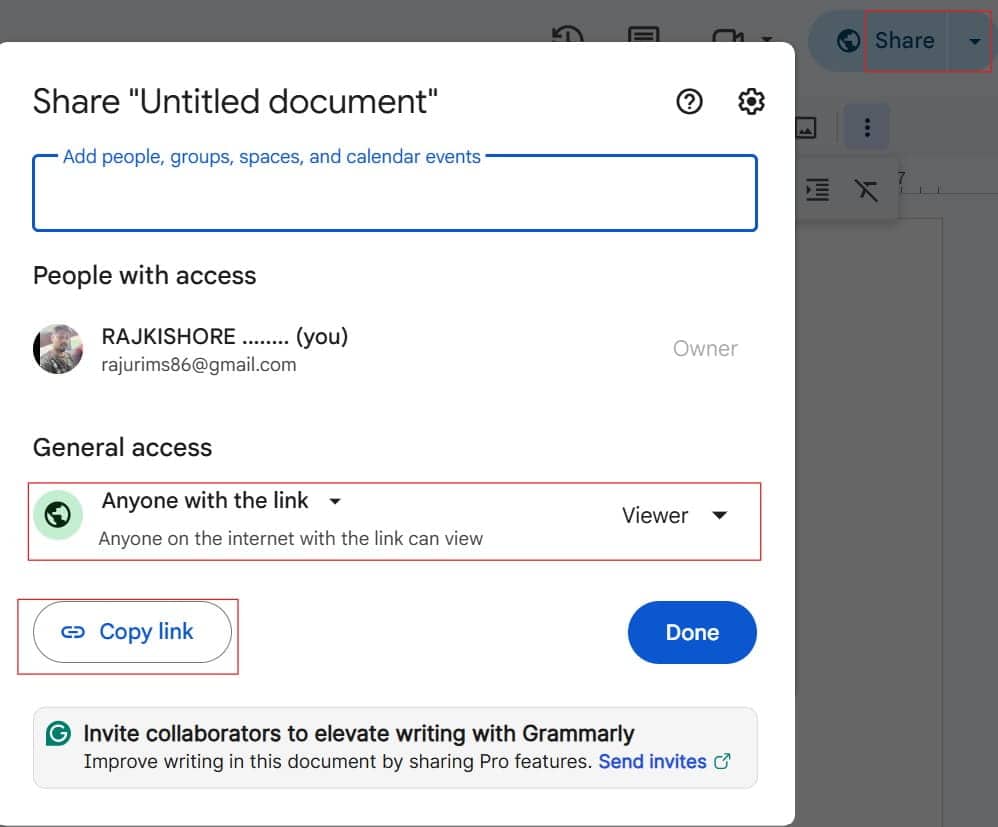
- Select Share at the top right.
- In the sharing window, find General access. It usually says Restricted.
- Click the dropdown and choose Anyone with the link.
- Click the role dropdown next to it, which may say Viewer, and choose Editor.
- Review the setting carefully. Check that it says Anyone with the link and Editor.
- Select Copy link, then Done.
See the screenshot below for reference.
Google may show a warning about making the file widely accessible. Read it before you confirm. Share the link only through channels you choose, such as a class email, a group chat, or a printed notice. If you want a shorter address for posters or messages, read how to shorten a Google Docs URL.
If you do not see Anyone with the link, your organization’s administrator may have restricted it. School and work accounts often block public editing. In that case, ask your administrator, or use a personal Google Account for non-sensitive documents.
See unable to change sharing settings in Google Drive for other causes, and Google Drive link sharing not working if people report problems opening the link.
Pro Tip: Test the link in a private or incognito window before you send it. If you can edit there, so can everyone else.
Step 3: Limit What Editors Can Do
By default, editors can change the document and also manage sharing. You can reduce that.
- Select Share.
- Click the Settings gear icon in the sharing window.
- Turn off Editors can change permissions and share. This stops editors from adding people or changing access.
- Review the other options. Depending on your account, there may be a setting that stops viewers and commenters from downloading, printing, or copying. These settings affect viewers and commenters, not editors.
- Select Back or Done to save.
Editors can still copy the text out, so these settings are not a security guarantee. They only reduce accidental sharing changes. Remember that settings can vary by account type and update.
Also consider the file location. If the document sits in a shared folder or shared drive, the folder’s access rules also apply. See if I share a folder in Google Drive, can they see my other folders? before you place the file in a folder with other documents.
Pro Tip: Keep open-edit documents in their own folder. Mixing them with private files makes accidents more likely.
Step 4: Expect Anonymous Editors
When anyone can edit, some people will do it without signing in. Docs shows them as anonymous animals in the document and as unnamed editors in version history. You will not see names or email addresses for those people.
That has consequences:
- You cannot tell who changed what.
- You cannot ask a specific person to fix a mistake.
- Anyone can type anything, including spam.
For a deeper look at how anonymous visitors appear, read how to view Google Docs anonymously. If you want accountability, use named access.
For people who do not use Gmail, sharing Google Docs with non-Gmail users shows how to invite them by email, and Google Docs without Gmail or a Google account explains what those users can do.
Pro Tip: If you need to know who edited, ask people to add their name next to every change. It is not perfect, but it helps for small groups.
Step 5: Monitor Changes and Restore Mistakes
An open document needs regular check-ins. Version history is your main tool. It stores earlier versions and shows who changed what, though anonymous editors appear without names.
- Select File, then Version history, then See version history.
- Click a version in the panel to preview it.
- If the current version has been damaged, select an earlier version and choose Restore this version.
- Confirm the restore.
Restoring replaces the current content for everyone, and anyone editing at that moment may lose recent work. Warn collaborators if you plan to restore. Before a restore, use Name current version if you want to keep the present text in the history.
For additional tracking, check how to check the activity on a file or folder in Google Drive. If the document is deleted or missing, see how to recover a file from Google Docs.
Set a routine. For a one-week sign-up list, check the file once a day. For a larger project, assign someone to watch it.
Pro Tip: Name a version each evening, such as “Clean Friday.” It gives you an obvious restore point.
Step 6: Close the Door When You Are Done
Open editing should have an end date. When the task is finished, reduce access.
- Download a backup. Select File, then Download, then PDF Document (.pdf) or Microsoft Word (.docx).
- Select Share.
- Change General access back to Restricted, or change Editor to Viewer if people still need to read it.
- Remove old comments if they contain private details. See how to delete comments in Google Docs.
- Check the sharing window to confirm the new setting.
Changing access affects everyone who has the link. Anyone currently editing will lose access, so warn them first. If you want a read-only version for the future, use how to make a Google Doc view-only. If people ask why they cannot edit after you close access, point them to how to remove view-only restrictions in Google Docs or ask them to request access.
Pro Tip: Set a calendar reminder for the deadline. Open-edit links often stay active for months because nobody remembers to close them.
Better Options Than Open Editing
Sometimes “editable by anyone” is not the best tool. Consider these alternatives.
- Commenter access. People can suggest changes without altering the text. This works well for feedback. Read how to add or hide comments in Google Docs.
- Named editors. Invite specific people by email. You will see who changed what.
- A form or spreadsheet. For sign-ups, a Google Form or a Google Sheet gives structured entries and easier moderation. Docs is not always the right container.
- View-only plus a contact method. Share a read-only version and ask people to email changes.
- Password protection. If you need a locked file, see how to lock Google Docs with a password for what is possible and what is not.
If someone is editing but you want them to stop, turning off editing mode in Google Docs explains how a person can switch to viewing for themselves.
Pro Tip: For anything with personal data, such as names and phone numbers, use named access or a form. A public edit link is a poor home for private information.
Privacy and Policy Considerations
Open editing raises privacy issues for you and for the people who add their information.
- Do not collect sensitive data. Avoid asking for home addresses, ID numbers, health details, or payment information in an open document. Anyone with the link may be able to read it.
- Think about children. For school documents, follow your school’s rules about names and photos, and do not publish student information in a public document.
- Respect organization rules. Companies and schools may prohibit public links for work files, even if the setting is available.
- Do not rely on obscurity. A hard-to-guess link is not a lock.
- Remember copies. Anyone who can read the document can copy its text, even if you later restrict access.
Never ask people to share passwords or verification codes in the document or by message.
Troubleshooting Open-Edit Problems
Start with simple checks.
- People still can’t edit. Check the role. It must say Editor, not Viewer or Commenter.
- They see a sign-in request. The file may still be Restricted, or the link was copied before you changed the setting. Copy it again.
- “Anyone with the link” is missing. An administrator may have blocked it.
- The page is full of junk. Restore an earlier version from version history and consider closing access.
- Text moves around. Several people are editing at once. Use a table with fixed rows and clear instructions.
- Mobile users cannot edit. They may need the Google Docs app, or their browser may open view-only. Ask them to try the app.
Frequently Asked Questions
How do I make a Google Doc editable by anyone?
Open the document, select Share, change General access to Anyone with the link, then change the role to Editor. Copy the link and send it. Your administrator may block this option on work or school accounts.
Can people edit a Google Doc without a Google account?
Often yes, when the link is set to Anyone with the link as Editor. They may appear as anonymous in the document. Some features may be limited, and behavior can vary by device and account type.
How do I stop someone from messing up an open Google Doc?
You can’t fully prevent it with open editing. Keep a backup, check version history regularly, restore earlier versions, and consider using Commenter access or named editors instead.
How do I make a Google Doc editable again after setting it to view-only?
Open Share, change the role from Viewer to Editor for the people or the link, and save. If you are not the owner, ask the owner for edit access.
Is it safe to let anyone edit a Google Doc?
It depends on the content. It can work for low-risk shared lists, but it is not safe for confidential or sensitive documents. Anyone with the link may be able to read, change, or copy the text.
You learned how to set Anyone with the link to Editor, how to limit what editors can do, and how to monitor, restore, and close an open document. Use open editing only for low-risk content, and return access to Restricted or Viewer as soon as the task is done. I hope you found this article helpful.
You May Also Like
- Google Docs for business
- Google Docs for students
- How to remove yourself from Google Docs
- Google Docs cannot remove from view
- How to make Google Docs available offline

I am Rajkishore, and I have over 14 years of experience in the Software Industry. For a long time, I have been using Google Docs, Google Drive, and Google Sheets for my document usage, and I am sharing all the tips and tricks, the challenges I have come across, and their solutions to use Google Docs for your day-to-day use. I hope you will learn from these practical Google Docs tutorials. Read more.