
You write a monthly sales report, paste in a screenshot of a chart, and then the numbers change. Now the picture is wrong, nobody can edit it, and you have to rebuild it from scratch. Or a student needs a clean bar chart for a science lab, but the document has no obvious graph button.
Here is how to make a graph in Google Docs the right way. Docs does not draw charts from typed numbers. It builds them from a Google Sheets spreadsheet, which Docs creates for you in Google Drive. Google Docs is the editor for your text, Google Sheets holds the data, and the chart links the two, so you can update the graph without starting over.
This guide shows how to insert a chart, enter data, customize the look, update or unlink it, share it safely, and fix common problems.
How Charts Work in Google Docs
A chart in Docs is connected to a spreadsheet. When you insert one, Docs creates a new Sheets file, usually with sample data, and shows the chart in your document. Editing the chart means editing the data in that spreadsheet.
This design has benefits and costs:
- Easy updates. Change a number in the sheet, then refresh the chart in Docs.
- Reusable data. The same spreadsheet can feed several charts and documents.
- Extra file. You now have a Sheets file to manage and share.
- Permission rules. Readers of the Doc do not automatically get access to the data sheet.
Docs offers bar, column, line, and pie chart types in the menu. More chart types, such as scatter and area charts, are available when you build the chart in Sheets and paste it into Docs. Menu names can vary by update.
Use the right chart type for the data:
| Chart type | Best for | Example |
|---|---|---|
| Column or bar | Comparing categories | Sales by region |
| Line | Trends over time | Monthly website visits |
| Pie | Parts of a whole | Budget share by department |
| Scatter | Relationship between two numbers | Study hours vs. test scores |
Pro Tip: Pick the chart type before you enter data. A pie chart with 12 slices is hard to read, and a line chart works better for many time points.
Step 1: Insert a Chart
- Open your document in Google Docs on a computer.
- Click where you want the graph to appear, usually on its own line between paragraphs.
- Select Insert, then Chart.
- Choose Bar, Column, Line, or Pie. You can also choose From Sheets to use an existing chart from a spreadsheet you already have.
- Docs inserts a sample chart and creates a linked spreadsheet in Drive.
See the screenshot below for reference.
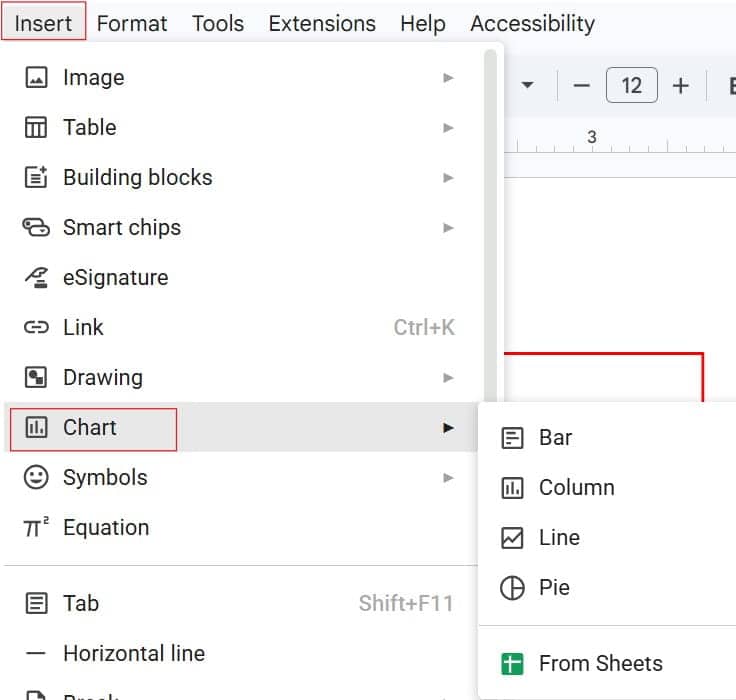
If you cannot find Chart, you may be using a mobile app or an account with limited features. Use a desktop browser, and check that you have Editor access to the document. Viewers and Commenters cannot insert charts.
The new chart is a placeholder with sample values. It is not your data yet, so do not send the document at this point. Your next step is to replace it.
Pro Tip: Click an empty paragraph before you insert the chart. If your cursor sits in the middle of a sentence, the chart can break the text awkwardly.
Step 2: Enter Your Own Data
To edit the numbers, open the source spreadsheet.
- Click the chart once to select it.
- Click the three-dot menu in the top right corner of the chart, or the link icon, and choose Open source. A new tab opens with the Sheets file.
- In Sheets, replace the sample data with yours. Put labels in the first column, such as months or product names, and values in the next columns.
- Use a header row so each data series has a name.
- Return to your document tab.
- Click Update on the chart if the button appears. The chart refreshes with the new numbers.
For example, a quarterly report might use this layout:
| Quarter | Revenue | Expenses |
|---|---|---|
| Q1 | 42 | 30 |
| Q2 | 48 | 33 |
| Q3 | 51 | 35 |
| Q4 | 60 | 38 |
Keep the data simple. Charts work best with clean tables: no merged cells, no blank rows in the middle, and consistent units. If you already have numbers in Excel, see how to insert Excel into Google Docs. If you need a table before the chart, read how to make a table in Google Docs.
Because the data lives in Sheets, you can also use formulas, sorting, and large datasets there. A guide to making a table chart in Google Sheets can help if you want to build the chart in the spreadsheet first.
Pro Tip: Name the spreadsheet clearly, such as
Q4-Sales-Chart-Data. A file called “Untitled spreadsheet” becomes a mystery six months later.
Step 3: Customize the Chart in Sheets
Appearance changes happen in the spreadsheet’s chart editor.
- In the Sheets tab, click the chart.
- Open the Chart editor by clicking the three-dot menu on the chart and choosing Edit chart. A sidebar appears.
- In the Setup tab, confirm the chart type and data range.
- Switch to the Customize tab.
- Edit these sections as needed:
- Chart style: background color, font, and border
- Chart & axis titles: add a clear title, such as “Revenue by Quarter (in thousands)”
- Series: change colors and add data labels
- Legend: position or hide it
- Horizontal and vertical axis: labels, scale, and number format
- Return to Docs and select Update to see the changes.
Good design makes charts easier to read. Follow these basics:
- Give every chart a specific title and label the axes with units.
- Use no more than five or six colors, and keep strong contrast between them.
- Avoid 3D effects, which distort values.
- Start bar chart axes at zero so bar heights compare fairly.
- Do not rely on color alone. Add data labels or patterns for readers who cannot distinguish colors.
- Pro Tip: Test the chart in grayscale. If you cannot tell the series apart in black and white, readers with color vision differences may struggle too.
Step 4: Resize and Position the Chart in Docs
Back in the document, make the chart fit the page.
- Click the chart. Blue handles appear at the corners.
- Drag a corner handle to resize it. Hold the corner to keep the proportions.
- Use the toolbar below the chart to set the layout: In line, Wrap text, or Break text. In line keeps the chart with the text and is the safest choice for reports.
- Center it using the alignment buttons. For help, see how to center an image in Google Docs.
- Add a caption below, such as “Figure 1. Revenue by quarter.”
If you work in a formal style, captions and figure labels may follow specific rules. See APA format in Google Docs for how a style guide affects documents. Also add alt text: right-click the chart and look for Alt text, then write a short description, such as “Column chart showing revenue rising from 42 in Q1 to 60 in Q4.” This helps screen reader users understand the content.
Linked charts behave as pictures in the page layout. You cannot crop them like photos in the same way, but an unlinked image copy can be trimmed; see how to crop a picture in Google Docs for that case.
Pro Tip: Keep a chart at least half the page width. Small charts become unreadable when printed.
Step 5: Update, Unlink, or Replace the Chart
Linked charts stay connected to the spreadsheet, which has consequences.
To update a linked chart:
- Change the data in the Sheets file.
- Open the Doc.
- Click the chart and select Update when it appears.
If someone else changes the data, you may see an update prompt when you open the Doc. Review the new chart before you send the report, because a change in the sheet can alter what readers see.
To unlink a chart:
- Click the chart.
- Open the link menu (the chain icon) and choose Unlink.
- Confirm. The chart becomes a static picture.
Unlinking cuts the connection. After that, you cannot refresh it from the sheet, and you cannot edit its data. Use unlinking when a report is final and you want the numbers frozen. This action is not easily undone, although you can press Ctrl+Z (Cmd+Z on Mac) right away.
To replace a chart: Delete the old one with Delete, then insert a new chart with Insert, then Chart. If you have a chart already made in Sheets, copy it there, return to Docs, paste it, and choose Link to spreadsheet or Paste unlinked.
Pro Tip: Before you unlink or delete, save a named version through File, then Version history, then Name current version. It gives you a restore point.
Sharing is where chart documents often go wrong. The Doc and the Sheet are separate files with separate permissions.
- A person who can open the Doc sees the chart image.
- Seeing the chart does not always mean they can open the source spreadsheet.
- If they click Open source and lack access, they will see a request-access screen.
- If you give them access to the sheet, they may see all its data, including hidden rows, notes, and other tabs.
Follow these safe practices:
- Keep the source spreadsheet limited to chart data. Do not store unrelated or private numbers in the same file.
- Share the Doc with named people through Share, and choose the lowest role needed. See Google Docs Commenter vs. Editor for the difference.
- Share the source sheet only with people who need to edit or inspect the numbers.
- For read-only distribution, send a PDF or use view-only sharing.
- Check General access before you send. Anyone with the link can expose the document, and a forwarded link may reach people you did not intend.
If the link does not work for recipients, read Google Drive link sharing not working. Administrators at work or school may also limit external sharing.
Keep chart data and documents organized in the same Drive folder, as explained in Google Drive folders. That makes it easier to find, move, and share them together.
Pro Tip: If the data is sensitive, create a separate, cleaned-up sheet for the chart. Do not link a public report to a spreadsheet full of private figures.
Export, Print, and Compatibility
Charts behave differently when they leave Google Docs.
- PDF. Select File, then Download, then PDF Document (.pdf). The chart appears as part of the page. Check it carefully.
- DOCX. Download as Word. Charts usually become static images, so they are no longer connected to the data. See how to save as DOCX and review the result.
- Printing. Colors may look different on paper. Use strong contrast and test a printout.
A downloaded copy is separate from the cloud original. Updating the Sheets data later will not change a PDF or DOCX you already sent. Re-export after every update.
If you lose a chart or text by mistake, use File, then Version history, then See version history to restore an earlier version. Restoring replaces current content, so name the present version first. For a missing file, see how to recover a file from Google Docs.
Frequently Asked Questions
How do I make a graph in Google Docs?
Select Insert, then Chart, and choose a bar, column, line, or pie chart. Docs creates a linked spreadsheet. Open the source, replace the sample data with yours, and select Update in the document.
Can I make a graph in Google Docs without Google Sheets?
No. Charts in Docs are built from a Sheets spreadsheet. Docs creates that file automatically, but your data lives there. You can draw simple shapes with the Drawing tool, though they are not data-driven.
How do I edit a chart in Google Docs?
Click the chart, open the link menu, and choose Open source. Change the data or customize the chart in Sheets, then return to the document and select Update.
Why can’t people see the data behind my chart?
The Doc and the spreadsheet have separate permissions. Readers see the chart but need access to the sheet to open its data. Share the sheet only with people who need it.
Can I make a graph in the Google Docs mobile app?
The mobile app may not offer the same chart tools. Create or edit charts in a desktop browser, and use the app mainly to view them.
You learned that a Google Docs graph is a linked chart built from a Sheets spreadsheet, and how to insert, customize, update, unlink, and share it. Keep the source data clean, remember that the document and spreadsheet have separate permissions, and share only with named people at the lowest role they need. I hope you found this article helpful.
You May Also Like
- Flow chart in Google Docs
- T chart in Google Docs
- How to make a word cloud in Google Docs
- How to make a grid in Google Docs
- Google Docs for students

I am Rajkishore, and I have over 14 years of experience in the Software Industry. For a long time, I have been using Google Docs, Google Drive, and Google Sheets for my document usage, and I am sharing all the tips and tricks, the challenges I have come across, and their solutions to use Google Docs for your day-to-day use. I hope you will learn from these practical Google Docs tutorials. Read more.