
A project plan has grown to 20 pages, and your team keeps asking where the budget is. Someone scrolls for a minute, someone else searches the Drive, and a third person emails a different file. A few well-placed links fix this. They put the answer one click away.
A Google Docs link to another document sends readers to a separate file, such as a budget sheet or a policy. A link within a document jumps to a heading or bookmark in the same file. Google Docs is the editor, and Google Drive is where those files are stored, so both kinds of links depend on access and file location.
This guide shows how to link to another document, link within a document, use smart chips, and fix problems. It also explains sharing settings so readers can open what you link.
Know the Four Types of Links
Before you start, choose the type that fits your task. Each solves a different problem.
| Link type | Where it goes | Best for |
|---|---|---|
| Web or file link | Another file or website | Policies, budgets, references |
| Heading link | A heading in the same document | Navigation in long reports |
| Bookmark link | Any marked spot in the same document | Specific paragraphs or tables |
| Smart chip (file chip) | Another Google file, with a preview | Team documents with quick context |
Menu labels can change between Docs updates, so look for the same words if yours differ slightly.
Pro Tip: Decide who reads the document before you add links. If readers can’t open the target file, the link only creates confusion.
Google Docs Link to Another Document
To connect two files, you first need the target file’s link. A link is a web address that points to a file or page. Google Drive files each have one.
- Open the target document in Google Docs or Drive.
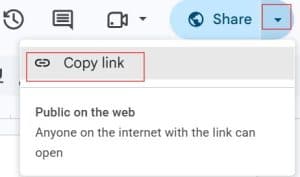
- Select Share at the top right, then Copy link. Check General access first, and set the file to the minimum audience that needs it.
- Go back to your main document.
- Select the words you want to turn into the link, such as “2026 budget sheet.”
- Press
Ctrl+Kon Windows or ChromeOS, orCmd+Kon a Mac. You can also choose Insert, then Link. - Paste the address into the link box.
- Select Apply.
Check out the screenshot below for your reference.
The text turns blue and underlined. Click it to see the link preview and options to edit, copy, or remove it.
Use descriptive link text such as “Q4 marketing plan” instead of “click here.” It helps readers scan, and screen reader users hear where the link goes. A long raw address also clutters your page. If you must share a clean address, see how to shorten a Google Docs URL.
You can also search from the link box. Start typing a file name, and Docs may suggest files from your Drive. Pick the file and select Apply.
Pro Tip: Link from stable file names. If you rename a file, the link still works, but readers may see old link text that no longer matches.
Link to a Document With Smart Chips
A smart chip is a small clickable element that shows details about a file, person, or event. For files, it appears as the file name with an icon. Hover over it to see a preview.
- Click where you want the chip.
- Type
@and start typing the file name. - Pick the file from the list. You can also use Insert, then Smart chips, and choose a file option.
- Press
Enterto insert it.
A file chip beats a plain link in team documents because it shows the file name and a preview without leaving the page. Hover to see who owns the file and when it changed. That helps readers decide whether to open it.
One important point: a chip does not give anyone access. If a reader can’t open the linked file, the chip shows a permission screen. When you insert a chip for someone who lacks access, Docs may prompt you to share. Read that prompt carefully before you click, and avoid giving broader access than you intended.
Pro Tip: Use chips for working files your team opens often, and plain text links for references that rarely change. Too many chips make a page look busy.
Check Sharing Permissions Before You Link
A link doesn’t share the file. It only points to it. Access depends on the target file’s sharing settings. This is the most common reason links fail.
- Viewer can read the linked file but not change it.
- Commenter can read and leave comments.
- Editor can change the content.
If your team needs only to read a policy, give Viewer. Learn the differences in Google Docs Commenter vs. Editor. To lock a file for reading, see how to make a Google Doc view-only.
Share with named people first. Setting General access to Anyone with the link may expose the target file to anyone who gets the address, including through forwarded emails. Avoid it for contracts, HR files, or student records. Before you send, check the recipient list and access level.
Your school or company may restrict external sharing, so the options you expect may not appear. If you need to include outside readers, read about sharing Google Docs with non-Gmail users. For readers who open links without signing in, see how to view Google Docs anonymously.
If sharing options are gray or blocked, see unable to change sharing settings in Google Drive. If the link opens but the file does not, Google Drive link sharing not working covers common causes.
Pro Tip: Open the document in a private window or ask a teammate to click the link. It’s the fastest way to learn what readers actually see.
Google Docs Link Within a Document
Long reports, proposals, and manuals are easier to use when readers can jump around. Docs gives you two ways: link to a heading or link to a bookmark.
Link to a Heading
A heading is a title formatted with a built-in style, such as Heading 1 or Heading 2. Docs lists headings automatically, so you can link to them without extra setup.
- Make sure your section titles use heading styles from the styles dropdown, which usually reads “Normal text.”
- Select the text you want to turn into a link, such as “See the budget summary.”
- Press
Ctrl+KorCmd+K. - In the link box, open Headings and bookmarks. The label can vary slightly.
- Choose the heading you want.
- Select Apply.
Clicking the link jumps to that heading. This is a good way to build “Back to top” or “Go to summary” links.
Headings are also what Docs uses for its navigation outline, so the same step improves accessibility. See how to add a table of contents in Google Docs to turn headings into a clickable list. If your headings need numbers, read about numbered headings in Google Docs.
Link to a Bookmark
A bookmark marks any location, such as a paragraph or table, even if it is not a heading.
- Click where you want the bookmark, or select the text.
- Select Insert, then Bookmark. A small bookmark icon appears in the left margin.
- Select the text you want to link from.
- Press
Ctrl+KorCmd+K. - Open Headings and bookmarks, choose your bookmark, and select Apply.
You can also click the bookmark icon to copy a link to it or remove it. If you delete the bookmark, any links pointing to it stop working, so check before you remove one.
Why use bookmarks instead of headings? Bookmarks reach places headings don’t, like a single sentence in a policy or a specific table row. Headings are easier to maintain because they follow the text if you rewrite it.
Pro Tip: Use headings for sections and bookmarks for exact spots. Name important sections clearly so the dropdown list stays easy to scan.
Link to a Specific Part of Another Document
Sometimes you want to send readers to a section inside a different file. You can do this with a bookmark’s link.
- Open the target document and create a bookmark at the spot you want.
- Click the bookmark icon and choose the option to copy the link.
- Go to your main document.
- Select the link text, press
Ctrl+KorCmd+K, paste the link, and select Apply.
Readers who click it open the other file at that bookmark, if they have access. Bookmark behavior can vary by browser and device, so test it on the devices your readers use.
If someone later deletes or moves the target section, the link opens the document at the top instead. Check your important links when you update the target file.
Pro Tip: Keep linked files in one folder. The guide to Google Drive folders shows how to organize related files, so moving or sharing the set is simpler.
Practical Examples
A student research paper. Link each citation note to a source document or note card in the same Drive folder. Use heading links at the top for “Introduction,” “Methods,” and “Conclusion.”
A project plan. Put smart chips for the budget, the timeline, and the risk log in one “Resources” section. The team can hover to preview without opening each file.
A company policy manual. Add a table of contents at the top, bookmarks on key definitions, and links to related forms. Set the manual to Viewer for most staff so only the owner edits.
Meeting notes. Link last week’s notes at the top. Link action items to the project plan so owners can find them quickly.
Pro Tip: After you finish a document, click every link once. Fix broken ones before you share.
Edit, Update, and Remove Links
Links need maintenance. To change one, click the link text and choose Edit from the pop-up. Update the text, the address, or both. To remove it, choose Remove link. This keeps the words but removes the link.
If you replace the target file, create a new link instead of assuming the old one will follow. Copying a document makes a new file with a new address, so links to the old file still point to the old one.
If someone edits a shared document and breaks links, version history can help. Open File, then Version history, then See version history, and restore an earlier version. Restoring replaces current content, so name the current version first. For missing files, read how to recover a file from Google Docs.
Troubleshooting Link Problems
Start with the simple checks.
- “You need access.” The reader lacks permission on the target file. Add them as a named person, or change access if appropriate.
- Link does nothing. Check that you applied it. Blue underlined text should open a link pop-up on click.
- Wrong file opens. You may have pasted an old address. Edit the link and paste the correct one.
- Bookmark link fails. The bookmark may have been deleted. Add it again and relink.
- Heading missing from the list. The text may not use a heading style. Apply Heading 1, 2, or 3.
- Link works for you, not others. Owners can open their own files. Test with a different account.
- Link breaks after download. Downloaded DOCX or PDF files keep web links, but links to bookmarks or Drive files may behave differently, and Drive links still need access. Test the download.
Frequently Asked Questions
How do I link to another Google Doc?
Copy the target file’s link from Share, select text in your document, press Ctrl+K or Cmd+K, paste the link, and select Apply. You can also type @ and choose the file to insert a smart chip. Readers still need permission to open the file.
How do I link to a section within the same Google Doc?
Apply heading styles to your section titles. Select the link text, press Ctrl+K or Cmd+K, open Headings and bookmarks, and choose the heading. For other spots, add a bookmark under Insert, then Bookmark.
Why does my Google Docs link say I need access?
The person opening the link doesn’t have permission on the target file. Share the file with them as a named person, or adjust access if it’s safe. School and company policies may limit what you can share.
Do links work in a downloaded PDF or Word file?
Web links usually carry over, but links to Drive files still require access, and internal bookmark links may behave differently. Download the file and click every important link to test it.
What is the difference between a bookmark and a heading link?
A heading link uses a title styled as Heading 1, 2, or 3. A bookmark can mark any spot, such as a single paragraph or table row. Headings update with your text, while bookmarks stay where you placed them.
You learned how to link to another document, link within a document, use smart chips, and fix broken links. The most important habit is to check sharing permissions on every linked file, because a link points to a file but does not grant access. I hope you found this article helpful.
You May Also Like
- Google Docs for business
- Google Docs vs. Word
- How to make Google Docs available offline
- How to save docs to Google Drive
- Google Docs keyboard shortcuts

I am Rajkishore, and I have over 14 years of experience in the Software Industry. For a long time, I have been using Google Docs, Google Drive, and Google Sheets for my document usage, and I am sharing all the tips and tricks, the challenges I have come across, and their solutions to use Google Docs for your day-to-day use. I hope you will learn from these practical Google Docs tutorials. Read more.